

IBAS Children’s Champions of 2026
With the interconnectivity facilitated by contemporary means of communication, news about the contamination of children’s toys broadcast last year in New Zealand and Australia reverberated around the world in a matter of days. The discoveries which led to the global alert were the result of deliberate actions taken by asbestos assessors and analysts, academics, parents and environmental and compliance experts. Each one of these accidental activists played a vital role in exposing the truth about the potentially deadly contents of widely available children’s toys.
Background
On a number of ordinary spring days in October 2025 analysts at the COHLABS in Brisbane, Australia, undertook the testing of commercial submissions using transmission electron microscopy (TEM) asbestos analysis protocols.1 These samples included colored play sand as well as isolated fiber bundles associated with imported materials. Analytical results confirmed the presence of tremolite asbestos in all samples, with both tremolite and chrysotile asbestos fibers detected in some samples. The results were reported to the clients according to contractual obligations and standard procedures.
In a July 30th email from Michael Shepherd – COHLABS’s Principal Occupational Hygienist – he reminded me that the use of the contaminated sand by children had potentially also exposed cleaners, educational facilitators and parents to asbestos. This is an important point to bear in mind as we follow the thread of this story.
The Podcast
On October 22, 2025, Mike recorded an episode entitled “TEM: Is it Asbestos or Not?” in the Asbestos Still Kills (ASK) podcast series with Robert McAllister and Jason Milner. According to his recollection this is what happened:
“During a discussion about unusual analytical findings encountered by the laboratory, I referred, in general terms, to recent TEM analyses that had identified asbestos in coloured play sands used within educational settings. This information was shared as an example of the types of materials that may require advanced analytical techniques for asbestos identification.
Following the podcast, Rob and Jason advised the relevant regulatory authorities, which subsequently initiated their own investigations. My understanding is that this notification was the catalyst for the regulatory response that followed in Australia and New Zealand.”2
“Sliding Door Moment”
This was the second ASK recording of the “TEM: Is it Asbestos or Not?” session. The first had been done some while previously but for unspecified reasons was not transmitted. The redo provided the opportunity for Mike to mention the unusual findings made at the Brisbane labs.
The Follow-up
Picking up the story, Rob explained what happened next:
“Michael’s comments immediately set alarm bells ringing for me. I recognised that the findings could have significant trans-Tasman implications, particularly given that these products were intended for use by children in schools, early-learning centres and homes.
On 5 November 2025, in my capacity as a FAMANZ (Faculty of Asbestos Management Australia and New Zealand) Director, I raised the matter directly with WorkSafe New Zealand during our monthly engagement and asked that it be investigated and checked with the relevant Australian authorities. Jason Milner supported that escalation, and we discussed the potential implications at length. Jason was the Director of Asbestos Management Consultants Limited and a former FAMANZ Director at the time and Principal Asbestos Advisor at Health New Zealand, along with the key driver behind the ASK podcast.”
Faculty of Asbestos Management Australia and New Zealand (FAMANZ)
Behind the scenes there were endless conversations about the way forward, with FAMANZ members playing a crucial role. In another email from Rob he explained the process which followed:
“FAMANZ was not acting as a regulator. Our role at FAMANZ was to identify the potential significance of the information, ensure it reached the appropriate agencies and provide technical support as the issue developed.
Following the initial response, FAMANZ supported and funded further independent testing of selected sand-based products purchased from major New Zealand retailers, including Kmart and The Warehouse. That testing identified asbestos in additional products, and the results were provided to the relevant regulatory agencies. FAMANZ continued to provide technical input on product sampling, analytical methods, environmental assessment and the management of affected schools and early-learning environments etc.
The New Zealand response then moved quickly. Product recalls were issued, further products were sourced and tested, and other independent New Zealand laboratory testing identified asbestos in additional coloured-sand products. FAMANZ continued providing technical input to WorkSafe, MBIE and other agencies on sampling, analytical methods, environmental assessment and the management of affected schools and early-learning environments.”3
Raising levels of public awareness was also part of the FAMANZ remit and the airing of the Asbestos Still Kills podcast and direct engagement with domestic and international journalists were key.
Support received from allies in organizations in New Zealand and Australia was decisive. Acknowledging their input, Rob said:
“Marta Roberts at WorkSafe New Zealand was pivotal to the New Zealand response. She engaged openly with FAMANZ, took the emerging technical evidence seriously and helped ensure it was considered and progressed through the appropriate regulatory channels. In my view, Marta went above and beyond what could reasonably have been expected of her as a regulator, and her contribution made a genuine difference.
Jackii Shepherd, a Director of FAMANZ and Fellow of the Australian Institute of Occupational Hygienists, also provided invaluable support. She helped progress the Australian side of the work, connected relevant technical contacts and stakeholders, and supported coordination between Australia and New Zealand as well.”4
First Asbestos Toys Recalls
On November 12, 2025, the Australian Competition and Consumer Commission (ACCC) and New Zealand’s Ministry of Business, Innovation and Employment (MBIE) issued their first recalls for asbestos sand products; both Creatistics Coloured Sand and Rainbow Sand had been made in China.5
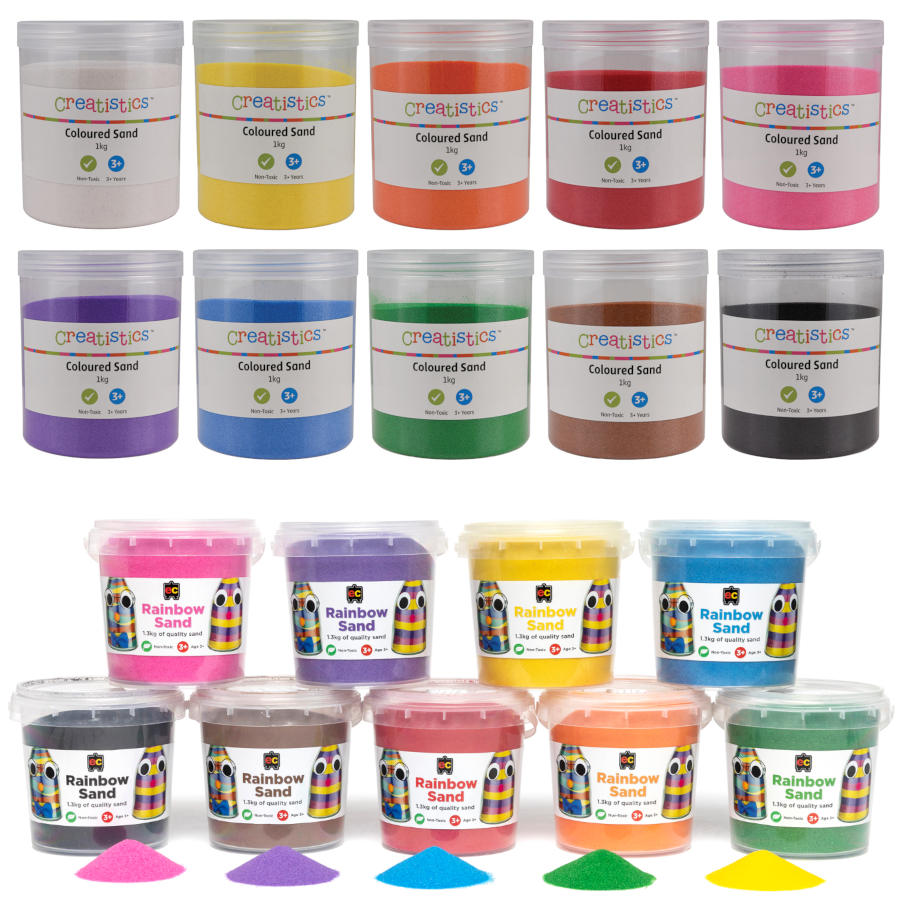 First sand products recalled in 2025 in Australia and New Zealand due to asbestos contamination. Images sourced from the ACCC website.6 |
Public Reaction in New Zealand
For parents in New Zealand there was little chance of escaping the news that their kids might have been exposed to carcinogenic fibers after the widespread media coverage following the recalls. In Christchurch, Elle Chrisp and David Dingwall, the parents of 3-year old twins, were horrified; their children had played extensively with the magic sand. They did what any concerned person would do and tried to find out more. This proved to be a formidable task. Many of us would have fallen at the first, tenth or even 50th hurdle; they didn’t.7
Having undergone legal training, neither Elle nor Dave were deterred by the brick walls they encountered when dealing with government officials and corporate representatives. The unanswered emails, denied requests and fruitless phone calls were grist to the mill. When government agencies and retailers refused to engage constructively with their enquiries, they submitted Official Information Act requests. What began as a routine consumer enquiry became a sisyphean quest to unveil the truth.
In April, 2026 they brought a case against Kmart, the huge Australian–New Zealand retailer, to the Disputes Tribunal; the asbestos-contaminated sand product purchased for their children had been sold by Kmart. They also lodged a complaint with the MBIE alleging that Kmart had “downplayed the health risks of its contaminated play sand, misled customers about their rights under the Consumer Guarantees Act, and refused to cover the cost of testing and decontaminating the homes where the sand had been used.” The case is ongoing.
Commenting on the motivations for their actions, Elle said:
“For parents like us who keep pushing on this, the goal is change. If nothing changes, this will keep happening, again and again. No one who actually understands what is at stake here would ever gamble with it. Even some accountability would be better than what is being delivered right now, which is absolutely nothing.”8
After much frustration, Elle and Dave unearthed what they termed “the origin document.” This text appears to be the one relied upon by schools, retailers and government agencies to reassure the public that “asbestos in play sand was low risk unless pulverized.” This comforting assertion, it turns out, was not backed by government testing; it was a desk review produced by an assessor who neither analyzed nor examined the sand.9 The assessor, according to a document authored by Elle and Dave:
“reviewed the importer’s own lab reports, discussed the matter with the importer, and concluded that fibre release was unlikely unless the sand was crushed or pulverised and that the risk to children was negligible. The report warns against extrapolating its own findings, and recommends the sand be eliminated from future deliveries. This document is the origin of the ‘low risk’ and ‘crushing or pulverising’ language that later appeared on recall notices in two countries.”
Ground-breaking Research in Auckland
As part of the Asbestos Still Kills Podcast team, Associate Professor Terri-Ann Berry from Auckland University of Technology (AUT)10 became aware of the disturbing findings made in Brisbane by COHLABS. To ascertain the real-world implications of the asbestos contamination, research was undertaken in New Zealand in 2025-26 by a team led by Terri-Ann and with scientific and financial support from the Environmental Innovation Centre. Additional financial and in-kind support was received from other New Zealand and Australian sources.
The analysts were investigating the liberation of asbestos fibers by play sand products during simulated children’s play. This was a world-first scenario-based research study simulating realistic children’s play activities with asbestos-contaminated toys. It was undertaken to evaluate the validity of reassurances provided by suppliers and government agencies that the asbestos contamination of the sand was “low risk” due to an inability to create airborne fibers.
To say the results were disturbing was an understatement:
“90% of tested craft sands released asbestos fibres into the air during play activities. Some fibres met the criteria for respirability. Air samples taken during experiments using moulding sand samples did not show any airborne asbestos fibres; however, analytical detection limits for this study were high. This demonstrates that the potential risk from asbestos in the product can create a real risk from fibres in the air; however, the magnitude of this risk has yet to be determined by further research. Nevertheless, no amount of risk of asbestos exposure through toys is acceptable so the most practical way to eliminate this risk would be to avoid the use of artificial sand products in toys or similar consumer products.”11
Scanning Electron Microscopy with Energy-Dispersive X-ray Spectroscopy was provided by Italian researchers Professor Elena Belluso, Professor Silvana Capella and Assistant Professor Jasmine Petriglieri at the University of Torino (UNITO), who undertook pro bono analysis of the sand samples.
Prior to the public release of the paper documenting the results of the experiments, on July 2, 2026 Terri-Ann disclosed the main research findings in, as one observer described it, “a measured public communication intended to explain the evidence responsibly.” 12 Commenting on the research, Terri-Ann said:
“I hope that we have provided some scientific evidence so that parents can make their own informed decisions about what is acceptable or not. Even more importantly, encourage better safeguards to be able to stop this happening again.”13
Upon receiving the full report, the Ministry of Health reconvened an advisory group to assess the findings and its chief medical officer confirmed that the disturbing news would be of concern to the public, parents and caregivers. New Zealand’s Commerce Commission announced that it had opened an investigation into what consumers were told. 14
Reaction
Following the various revelations in Australia and New Zealand, campaigners in other countries began to look more closely at their supply chains and question whether children’s toys in their countries were similarly contaminated.15 As one of those doing the questioning in the UK, I found the authorities unwilling to engage constructively with this issue.16 It took an article confirming asbestos contamination in a UK-sold product which appeared in the January 24, 2026 issue of The Guardian to get the government to take notice.17 The first UK asbestos recall issued by the Office of Product Safety and Standards (OPSS) took place on January 27, 2026.18 As of August 8, 2026, 64 OPSS asbestos recalls were issued withdrawing almost 120 toys and/or children’s craft products from UK markets.19
 March 9, 2026 screenshot showing some of the children’s products which had been recalled in the UK due to asbestos contamination. |
Elsewhere a few national authorities issued recalls, most did not. The European Commission’s Safety Gate system – a “rapid alert mechanism for dangerous non-food products – lodged 57 recalls as of August 8, 2026; most, if not all, of the toxic products had been made in China.20
Commenting on bilateral discussions in Beijing and Shanghai on March 31-April 2, 2026, Chair of the EU’s Internal Market and Consumer Protection Committee Anna Cavazzini said:
“It was important to come to China to meet with our counterparts and representatives of key e-commerce companies, to explain our rules in person. We have seen the e-commerce model shifting dramatically in recent years – it is a new reality but not a sustainable one if the rules are not enforced. While all consumers should have access to affordable consumer products, they should not have to worry about their health and safety when shopping.
More needs to be done to ensure companies are held accountable when rules are not followed. Whether it is about selling consumer products, removing dangerous toys from the market before they reach children, or paying customs fees – the same rules apply to everyone. We want to see rapid improvements and we want to ensure that our warnings are being taken seriously by China’s authorities and companies.”21
Meanwhile Back in Auckland
Occupational Hygienist Benjamin Alford is the Director and Principal Consultant of Aerem, an environmental consultancy and asbestos testing laboratory based in Auckland. He was not only a close observer of the evolving story but also an active participant, undertaking analytical work through the Aerem laboratory, with additional analytical support from Eurofins.
According to Ben, the Aerem and Eurofins findings helped provide a stronger technical foundation to challenge the “low risk” rhetoric that had been used to reassure the public. The results also helped demonstrate why the issue could not simply be reduced to whether asbestos was present above or below a reporting threshold.
In selected samples, Aerem’s independent bulk analysis identified tremolite at approximately:
- white craft sand: 3.5% by PLM and 3.3% by TEM;
- green craft sand: 1.8% by PLM and 2.6% by TEM;
- black sand: TEM trace tremolite despite a PLM non-detect.
Commenting on the results, Ben said in one of his LinkedIn posts:
“The asbestos percentages identified helped establish the nature and extent of the contamination and provided context for evaluating the potential risk posed by loose material during foreseeable use. For me, this has always been about protecting children, ensuring the evidence is communicated honestly, and challenging premature reassurance where the science has not justified it.”
Like many people, I have followed Ben’s LinkedIn posts for clear and accessible explanations of technical issues outside my own area of expertise. He has a particular ability to explain complex asbestos analysis and risk issues in language that can be understood by professionals, parents and the wider public. This skill was put to good use in his article entitled: The Sand Problem Goes Global: How Australia and New Zealand Forced the World to Pay Attention which was uploaded to the IBAS website on March 3, 2026.22
Since Ben’s first LinkedIn commentary on the asbestos contamination of play sand appeared in November 2025, many others have followed. His graphics summarize the status quo in a way that is easy to grasp, and his posts on LinkedIn and Facebook have brought the story to the attention of people outside the professional asbestos community. His advocacy has been an important catalyst in widening awareness of the threat to children posed by these contaminated products.
Asked whether his motivation was personal, he told me:
“There is a very personal and emotional side to this issue for me. My two boys have played with these types of toys. I therefore approach this not only as an occupational hygienist, asbestos analyst and business owner, but also as a father. That personal connection is one of the reasons I have been so vocal. When a product designed for children is found to contain asbestos, the discussion cannot be reduced to technical reporting limits or carefully worded corporate statements. Parents reasonably expect toys placed on the market to be safe. Professionally, I want the evidence to be accurate and the risks communicated responsibly. Personally, I want to know that my children, and every other child, are being properly protected.”23
IBAS Children’s Champions 2026
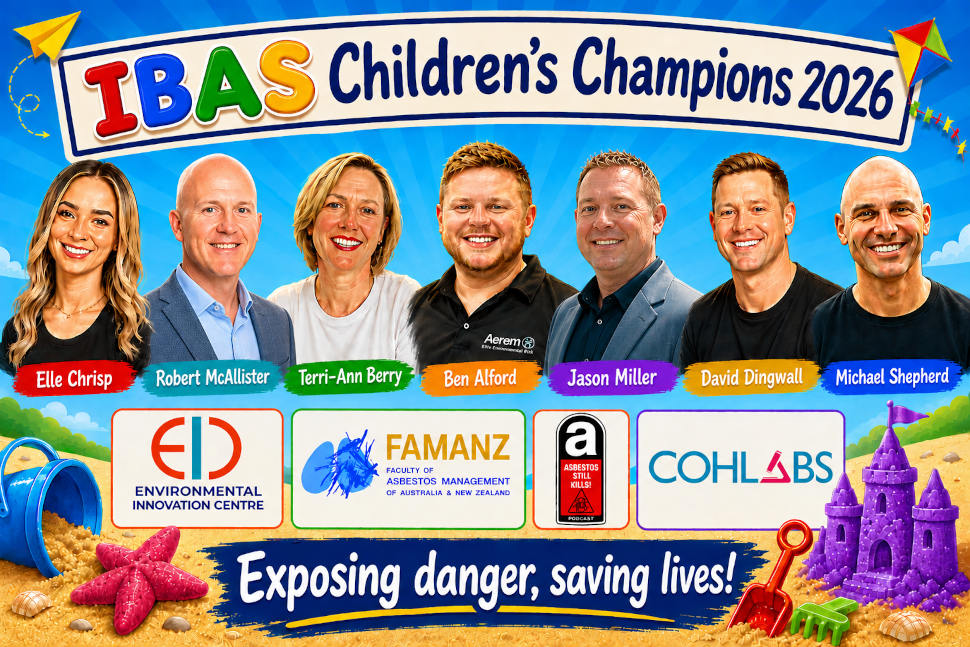
For all the reasons discussed above, the recipients of the IBAS Children’s Champions Award 2026 are:
- Elle Chrisp and David Dingwall
- Benjamin Alford
- Terri-Ann Berry and the Environmental Innovation Centre team
- Michael Shepherd and the COHLABS team
- Asbestos Still Kills Podcast (ASK)
- Robert McAllister, Jason Milner and the Faculty of Asbestos Management Australia and New Zealand (FAMANZ)
 |
Every one of them is a hero. Individually and collectively, we owe them a huge debt of gratitude for their commitment in challenging the official narrative and uncovering the truth about the composition of children’s toys. They were not afraid to take uncomfortable positions and confront powerful interests. Their efforts kick-started worldwide campaigning to implement measures ensuring that children’s lives were prioritized over commercial profits. Having thrown down the gauntlet, it is up to all of us to carry on the work they began. We salute you one and all!
August 13, 2026
_______
1Email from Michael Shepherd received July 27, 2026.
2 Email from Rob McAllister received July 27, 2026.
WorkSafe refers to WorkSafe New Zealand which is the country’s “primary work health and safety regulator.”
https://www.worksafe.govt.nz/
MBIE: New Zealand’s Ministry of Business, Innovation and Employment.
https://www.mbie.govt.nz/
3 Email received from Rob McAllister on August 6, 2026.
4 Australia ACCC. Customers warned of recalled children’s sand due to asbestos risks. November 12, 2025.https://www.accc.gov.au/media-release/customers-warned-of-recalled-children%E2%80%99s-sand-due-to-asbestos-risks
5 New Zealand Government. Recall of EC Rainbow Sand and Creatistics – Coloured Sand (1.3kg) due to potential asbestos contamination. November 12, 2025.https://www.mbie.govt.nz/about/news/recall-of-ec-rainbow-sand-and-creatistics-coloured-sand-1-3kg-due-to-potential-asbestos-contamination
5 ACCC. Customers warned of recalled children’s sand due to asbestos risks. November 12, 2025.
https://www.accc.gov.au/media-release/customers-warned-of-recalled-children%E2%80%99s-sand-due-to-asbestos-risks
6 McLeod, C. Elle’s twins played with asbestos-contaminated coloured sand for a year. Why wasn’t she warned of its danger? August 8, 2026.
https://www.theguardian.com/australia-news/2026/aug/09/asbestos-contaminated-coloured-sand-danger-new-zealand-elle-twins
7 Kazan-Allen, L. Wake-up Call for National Regulators. May 8, 2026.
http://ibasecretariat.org/lka-blogzxa247.php
8 McLeod, C. Parents were told asbestos in play sand was low risk unless ‘pulverised’. But regulators hadn’t tested it. July 19, 2026.
https://www.theguardian.com/australia-news/2026/jul/20/play-sand-asbestos-safety-assurances-australia-nz-based-on-supplier-assessment
9 Dr Terri-Ann Berry is an Adjunct Professor of Southern Cross University (Australia), a Co-Director of the research consultancy,Environmental Innovation Centre and Chair and Co-founder of the Mesothelioma Support and Asbestos Awareness Trust Charity.
10 TEM analysis undertaken by a laboratory in the US confirmed the presence of asbestos fibers or structures in relevant samples.
Berry, TA., Low J., Steinhorn, G., et al. Determination of Asbestos Fibre Release Potential from Contaminated Craft Sand and Sand-Based Toys. July 26, 2026.
https://chemrxiv.org/doi/pdf/10.26434/chemrxiv.15006130/v2
11 Wilson, K.B. ‘Incredibly disheartening’: Airborne asbestos found in children's play sand. July 2, 2026.
https://www.rnz.co.nz/news/health/651994/incredibly-disheartening-airborne-asbestos-found-in-children-s-play-sand
12 Email from Dr Terri-Ann Berry received July 24, 2026.
13 Ibid.
14 Kazan-Allen, L. Oversight Gaps in Global Supply Chains Facilitate Sale of Toxic Toys. April 23, 2026
https://ibasecretariat.org/lka-oversight-gaps-in-global-supply-chains-facilitate-sale-of-toxic-toys.php
15 Kazan-Allen, L. Asbestos Complacency in Westminster. December 20, 2025.
https://ibasecretariat.org/lka-asbestos-complacency-in-westminster.php
16 Tims, A. Asbestos found in children’s play sand sold in UK. January 24, 2026.
https://www.theguardian.com/business/2026/jan/24/childrens-play-sand-hobbycraft-asbestos-removed-recall
Kazan-Allen, L. Global Challenges, National Responses. March 5, 2026.
https://ibasecretariat.org/lka-global-challenges-national-responses.php
17 OPSS. Product Recall: Hobbycraft Giant Box of Craft (2601-0364). January 27, 2026.
https://www.gov.uk/product-safety-alerts-reports-recalls/product-recall-hobbycraft-giant-box-of-craft-2601-0364
18 This figure of ~120 comes from a review of the OPSS website on August 8, 2026; decorative doorstops listed as recalled for asbestos contamination were excluded from the total. As many of the 64 OPSS asbestos recalls in 2026 covered multiple items, it was estimated that the number of toxic toys and/or children’s craft products withdrawn from sale was ~120.
OPSS. Product Safety Alerts, Reports and Recalls – Asbestos. August 8, 2026.
https://www.gov.uk/product-safety-alerts-reports-recalls?keywords=asbestos&page=2&product_alert_type%5B%5D=product-recall&product_recall_alert_date%5Bfrom%5D=01%2F01%2F2026
19 EU Safety Gate: Asbestos Recalls. Accessed August 8, 2026.
https://ec.europa.eu/safety-gate-alerts/screen/search
As on the OPSS website, the origin of some of the recalled toys was marked as unknown; the vast majority of the recalled products came from China.
20 Kazan-Allen, L. Oversight Gaps in Global Supply Chains Facilitate Sale of Toxic Toys. April 23, 2026
https://ibasecretariat.org/lka-oversight-gaps-in-global-supply-chains-facilitate-sale-of-toxic-toys.php
21 Alford, B. The Sand Problem Goes Global: How Australia and New Zealand Forced the World to Pay Attention. March 3, 2026.
https://ibasecretariat.org/ba-sand-problem-goes-global-how-australia-and-new-zealand-forced-the-world-to-pay-attention.php
22 Email received from Ben Alford July 28, 2026.
